ICSE vs CBSE vs IGCSE - Right Education Board for Your Kids
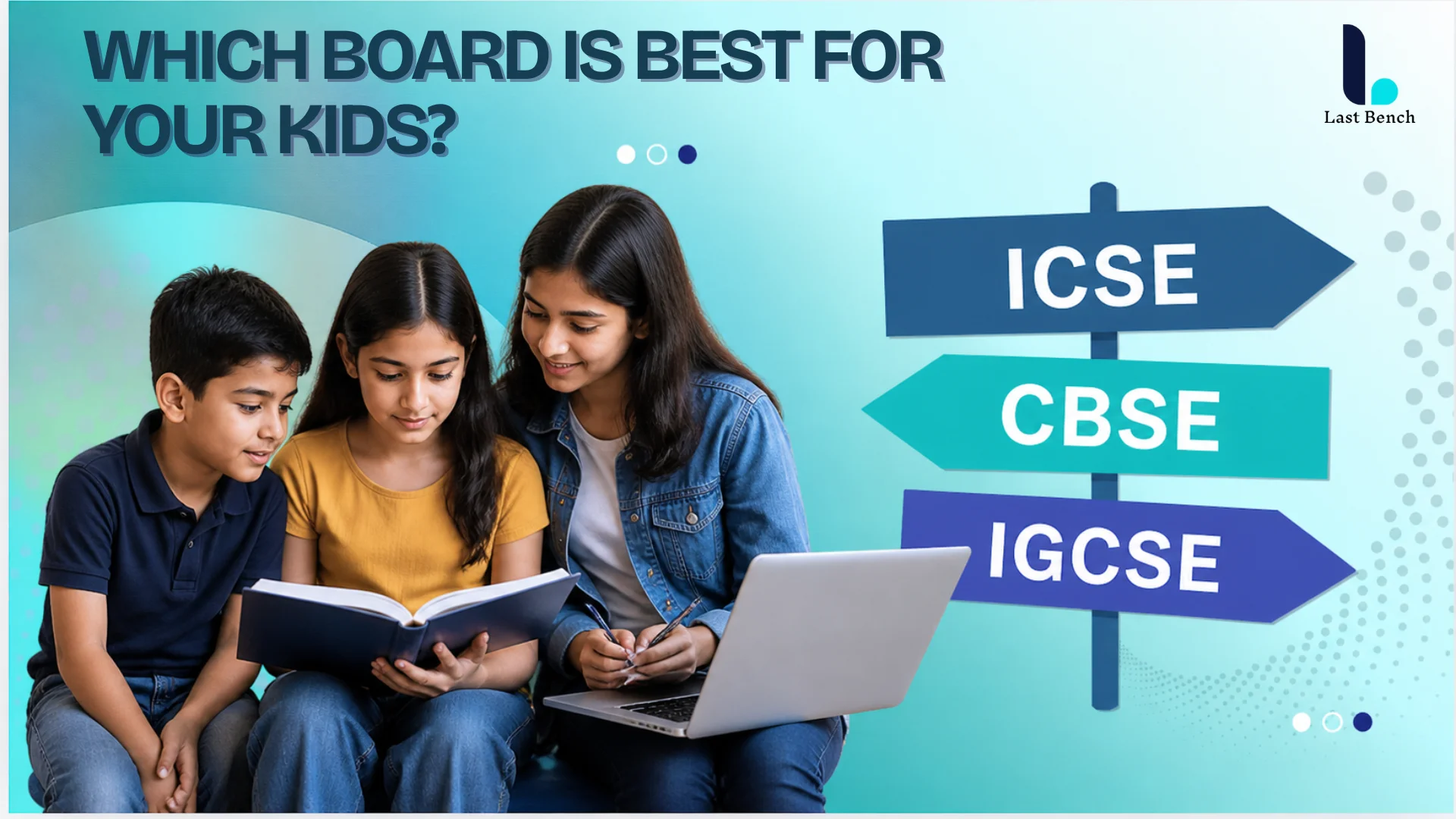
Selecting the appropriate education board to your child is not merely about academics but it is also about the future of your child, the way he or she learns, his/her confidence, and his/her career. ICSE, CBSE and IGCSE are three most discussed boards in India and elsewhere.
The strengths, teaching strategies and results of each board are different. Whereas one would be the best in competitive exams, another one would be more concerned with holistic development or international exposure. This is why it is very important to comprehend the difference between ICSE, CBSE and IGCSE before making a decision.
This step-by-step guide will take you through all the things you need to know, not name of school or level of study, but knowing what is the best fit, the best fit, and the best fit, of the many choices available to you.
Understanding the Three Boards

1. ICSE - Indian Certificate of Secondary Education
ICSE is known to possess an elaborate, balanced and comprehensive curriculum. It pressures on good language skills, more so English, and the equal emphasis on subjects of science, arts and commerce. The board promotes profound knowledge and critical thinking.
2. CBSE - Central Board of Secondary Education
CBSE is a board of national level which is followed by most of the schools in India. It is structured, easy and highly in touch with competitive examination like the JEE and NEET. The syllabus of this subject is designed in such a manner that it can be handled by the students and is friendly to them as well.
3. IGCSE - International General Certificate of Secondary Education
Curriculum Structure: Depth vs Simplicity vs Flexibility
The largest variation between ICSE, CBSE, and IGCSE is in the mechanisms of designing of the syllabus.
- ICSE Curriculum
- ICSE provides an in-depth and comprehensive syllabus. Students learn a great variety of topics and every topic is studied thoroughly.
- Equity in emphasis on languages, sciences and arts.
- Emphasis on project work and internal assessments
- Promotes a robust conceptual knowledge.
- CBSE Curriculum
- CBSE is characterized by a short and systematic method.
- Specialize in such core subjects as Maths and Science.
- Syllabus is simplified and simple to follow.
- Mainly based on NCERT textbooks.
This has made CBSE a favorite among those students who target to enter into entrance exams since the syllabus is directly related to them.
- IGCSE Curriculum
- IGCSE is exceptional in that it is flexible and internationally relevant.
- Learners have many options of subjects. Concentrate on learning through application.
- Promotes independent research and thought.
- The curriculum is not so much about memorization, rather it is more about the sense of understanding concepts in real life situations.
Difficulty Level: Which Board is More Difficult?
It is one of the most widespread questions of parents.
- ICSE is usually regarded as the most detailed and challenging, because of the large size and detail of the syllabus.
- CBSE is relatively simpler to handle, and keen concepts are targeted.
- IGCSE is not always easy, but is concept-based and not content-driven.
To make it simple, if in your case your child is an enthusiast in reading, writing and profound learning then ICSE would suit him or her well.
In case your child wants to be clear and study exams → CBSE is perfect.
When your child prefers to learn practically → IGCSE will suit well.
LEARNING STYLE AND TEaching methodology
While looking at the Learning Style and Teaching Methodology. All boards have a different teaching philosophy.
ICSE
- Focus on theory + practical understanding
- Encourages analytical and descriptive answers
- High importance given to language and expression.
CBSE
- Concentrate on the clarity of concepts and preparation of exams.
- Encourages objective-based learning
- Structured approach to topics
IGCSE
- Emphasize practical and skill-oriented instruction.
- Promotes conversation, research and problem solving.
- Less memorization, more practice in the real world environment.
Language and Communication Skills.
The process of language development is key to the development of general personality.
- ICSE lays an emphasis on English grammar, literature and writing skills.
- CBSE is concerned with the fundamentals of communication and not at all in depth.
- IGCSE is based on international standards of the English language.
ICSE and IGCSE boards are likely to produce more skilled writing and communication skills, which may come in handy in the tertiary education and the workforce.
Evaluating and Testing Pattern.
- ICSE
Combination of in-house tests and end-tests. - Incorporates projects, practicals and coursework.
- Focus on detailed answers
CBSE
- Primarily exam-based evaluation
- Use of objective-type questions more frequently.
- Structured marking scheme
IGCSE
- Integration of course work and written tests.
Concentrate on practice.
Different subjects are assessed differently.
Competitive Exam Preparation
Competitive examinations are a major objective to many students in India.
- CBSE is most consistent with such exams as JEE, NEET, and UPSC.
- ICSE students might require extra coaching to align exam patterns.
- Students doing IGCSE frequently must make the transition in case they are to prepare to take Indian entrance exams.
In case your child is already geared towards engineering, medicine, or government exams, CBSE can offer a more streamlined route.
International fame and prospects.
This section should be of interest to you in case you are considering an international education.
- IGCSE is popular among many universities across the globe.
- ICSE is known throughout the world but primarily India-oriented.
- CBSE is accepted in India and some international institutions
Subject Choices Flexibility
- ICSE is moderately flexible.
- CBSE has limited subject combinations
- IGCSE is the subject that enables students to select subjects according to the interest.
This flexibility of IGCSE assists the students to discover their strong points at an early age
Availability of Schools
CBSE enjoys the largest presence in India. There are fewer but ICSE schools are located in large cities. IGCSE schools are predominantly found in urban and international schools. In case you are likely to change the location often, CBSE tends to be the most convenient to use.
Cost and Affordability
- CBSE: Most affordable
- ICSE: Moderately priced
- IGCSE: Usually the most expensive
IGCSE schools often include advanced infrastructure and international-level facilities, which increases the cost.
Pros and Cons of Each Board
Pros of ICSE
- Strong language skills
- Detailed syllabus
- Balanced education
Cons of ICSE
- Heavy workload
- Time-consuming
Pros of CBSE
- Competitive exam alignment
- Easy to understand
- Widely available
Cons of CBSE
- Less focus on language depth
- More exam-oriented
Pros of IGCSE
- Global recognition
- Flexible subject choices
- Practical learning approach
Cons of IGCSE
- Expensive
- Not fully aligned with Indian exams
WHICH BOARD SHOULD YOU CHOOSE?
The right board depends entirely on your child’s needs and future goals.
Choose ICSE if:
- Your child enjoys detailed and descriptive learning
- You want strong English and communication skills
- You prefer balanced subject exposure
Choose CBSE if:
- Your child is preparing for competitive exams
- You want a simple and structured curriculum
- You may relocate frequently
Choose IGCSE if:
- You want international exposure
- Your child prefers practical learning
- You are planning for education abroad
Common Mistakes Parents Make While choosing a board
Many parents follow trends instead of understanding the child’s needs. Choose based only on difficulty level Ignore teaching style and learning preferences. Focus only on marks, not skill development. It can be a significant difference to avoid these mistakes.
There is no one particular board that is the best board but the best board is the one that best fits your child.
ICSE develops good basic and language concepts.
CBSE eases the learning process and promotes competitive exams.
IGCSE makes students ready to live in a global future.
The trick is that you have to know the manner in which your child learns, what interests the child and what are their long term goals before making a decision.
Today education is not only about the textbooks and the exams but about the development of skills, confidence and flexibility. It does not matter which system you pick and choose whether it is ICSE, CBSE or IGCSE, but what really counts is how the system is able to help your child grow.
You need to take the time to research, go to schools and even talk to teachers, where possible. A wise course of action now can determine a better and more prosperous future of your child.

